

I can’t speak for every writer, but for me it’s, “What’s your book about?” Because half the time, I don’t know myself.
My novel Demon Drink came out in April 2025 and I’ve spoken and written about it dozens of times since. Most of those words discussed the plot, the characters, the inspiration, the process, even the themes. But it wasn’t until a few weeks ago that, in a flash of insight, I understood what the book was really about.
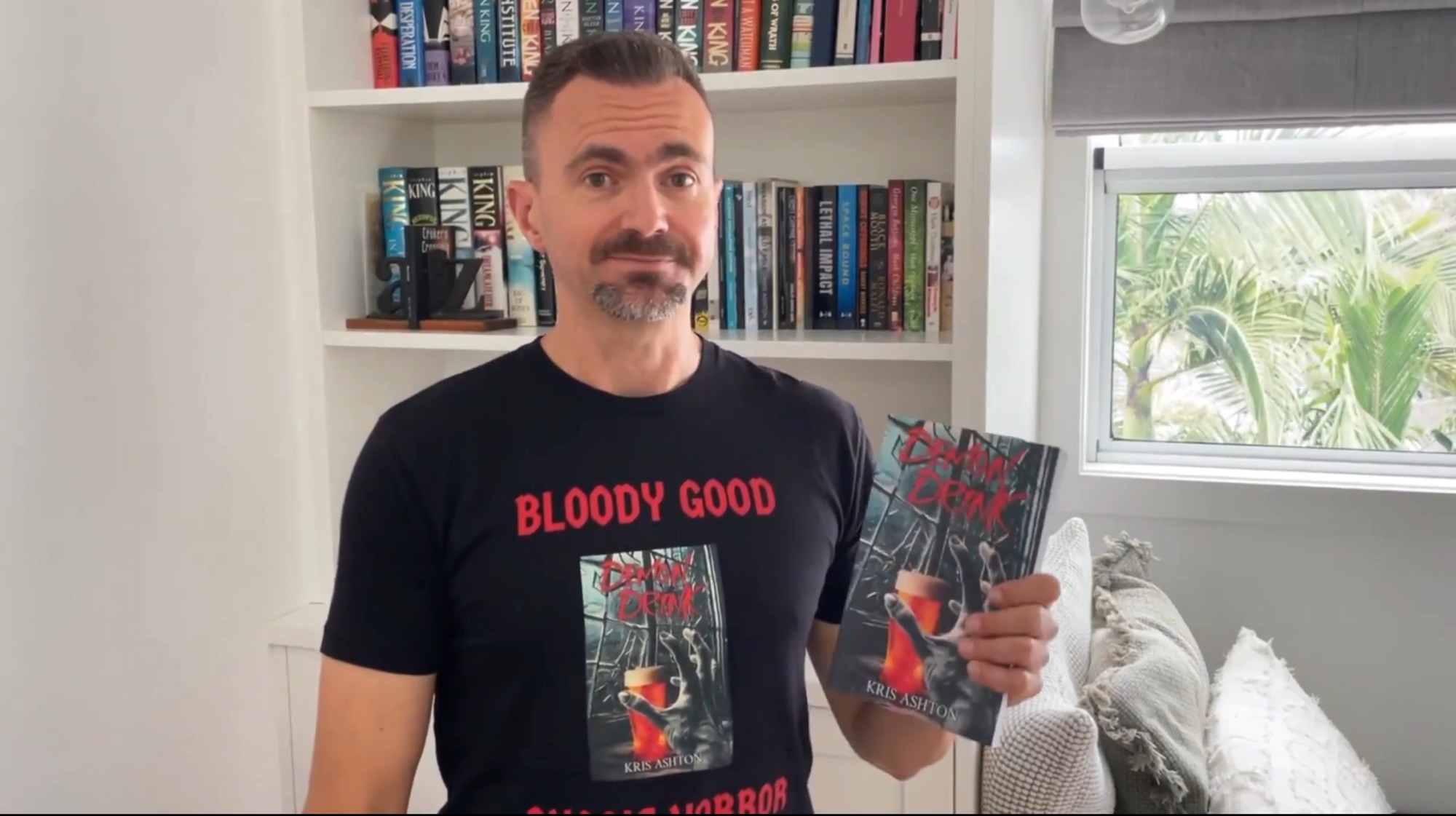
In various articles and interviews I suggested Demon Drink was about addiction, alcoholism, coping with change, faith (both Christian and secular), and redemption. But somehow the overarching theme had eluded my notice, like a man who doesn’t see a bridge because he’s standing right under it.
Then one evening I was in the shower, reminiscing about the book’s characters for some reason, and suddenly I saw the common denominator between them all: grief.
Demon Drink is a rumination on grief in all its forms.
Shirley Goodsall grieves for her broken marriage and its effects on her daughter, Elle.
Don Winslow grieves for his wife, the use of his arm, and the respect his role as Black Wattle’s police sergeant once afforded him.
Truman Smythe and Patrick Burnham grieve for their lives before they succumbed to addiction (and Truman will have several more reasons to grieve before the book reaches its conclusion).
It seems so obvious… now. But how, you might ask, does a guy write a 270-page book with no idea what it’s about?
I suppose it’s because, for me, writing fiction has always been about the high concept. The ‘what if’ scenario kicks off the creative chain reaction that leads to a 100,000-word storyline with detailed characters and settings. I’m usually dimly aware of themes emerging as I write, but I’m not an author who keeps such concerns at the forefront of his mind. On the odd occasion when I’ve tried to do that, composition becomes like walking uphill through wet concrete.
There’s another reason. Anyone who grew up during the 1980s in a stoic Australian household knows you never address the hard stone of grief directly (and that goes double if you’re a man). Rather, you sort of shut it away in the darkened recesses of your mind and let your subconscious grind it down to a powder.
Grist for the mill, you might say.
Between 2010 and 2020 (when I first conceived the idea that would become Demon Drink), grief besieged my life again and again, like a recurring infection. During that decade, my wife and I endured as much loss and heartache as many people do in a lifetime.
When faced with any adversity, especially grief, my response has always been to ignore the pain, put my head down, and go harder. But the subconscious doesn’t work that way. It is, to use a pungent American term, ornery; it goes about its business with little if any regard for the mind’s more rational inhabitants.
It’s business during that period was to take the real-life grief I’d repressed into its eldritch and isolated chamber and use it to form the primary thematic foundation for Demon Drink. All without the conscious me noticing.
If you’re interested in reading the fruits of my tortured unconscious, my publisher Crystal Lake is launching a massive website sale this weekend. As this artwork suggests, it runs through till Halloween. Just visit the site, enter the special code TREATTHEAUTHOR, and you’ll get a 20% off coupon for Demon Drink and hundreds of other Crystal Lake titles.
Happy (and affordable!) reading.


 Kris Ashton
Leave a comment