
Multi-part fiction series almost always end up disappointing readers. So why do publishers love them so much?
Ever since Stephen King decided to stop writing good books and start writing political diatribes masquerading as poorly edited fiction, my go-to author has been Keith Rosson. He got his start with Meerkat Press, a small publisher with a lot of nous, and he drew enough plaudits to score a contract with Random House.
His first book with RH, Fever House, was an absolute masterpiece of literary horror – a compelling story and finely drawn characters woven together with Rosson’s evocative and enviable prose. It’s safe to say, then, I was anticipating its sequel – The Devil by Name – more than any book in many, many years.
And when I finally got my hands on it, I was delighted. Rosson’s writing, which I first fell in love with while reviewing his short fiction collection Folk Songs for Trauma Surgeons, was as vital and visceral and musclebound as ever.
So why did I keep putting the book down?
I had burned through Fever House, you see, gulping down every page as fast as my failing eyesight would allow (I finally bought reading glasses a couple of months later). But even with specs on, I found my mind wandering from The Devil by Name. I’d read a chapter, maybe two, then set it aside.
It dawned on me, as the novel’s pace picked up in the final third, that it just wasn’t very good. I don’t mean at a language level – Rosson is among the finest practitioners of the craft working today. If you step back and observe Devil in a wider frame, however, the problems become obvious. Too much back-story. Characters that are hard to relate to or lack pathos (one, God help us, is the notorious ‘Magical Negro’ trope). Excessive focus on the machinations of government and its operatives. A fatalistic and somewhat illogical climax. Perhaps most disappointing, the book seemed ‘passive’ – the very antithesis of everything Rosson had written before.
I therefore wasn’t surprised to discover this remark from the author in the acknowledgments: “Okay, look, if writing a book is tough – and oh, it usually is – writing its sequel can at times feel insurmountable.”
I’ve long posited the theory that novels are almost always singular things. While movies can occasionally fluke a great sequel (Aliens, The Godfather II), it seems next to impossible with a work of fiction. Doctor Sleep, Stephen King’s sequel to The Shining, was atrocious. Go Set a Watchman, the posthumously published sequel to Harper Lee’s classic To Kill a Mockingbird, couldn’t capture its predecessor’s magic.
Yet thanks to the success of Harry Potter, Game of Thrones, et al., publishers have become obsessed with sequels. The idea of a standalone novel is anathema to them. The few genre publishers that accept unsolicited manuscripts often want to know if a submitted novel is one in a planned series. This is ‘bottom line thinking’. “Hey, if this book sold x copies, then a second one will double our profits!”
Now, that attitude is all well and good if an author conceived a multi-part epic from the outset, but I suspect Keith Rosson had no intention of writing a sequel when he tapped the final keystrokes on Fever House – and I further suspect that’s why writing The Devil by Name proved such a painful and constipated process. He didn’t really want to write a sequel, and the composition became a chore.
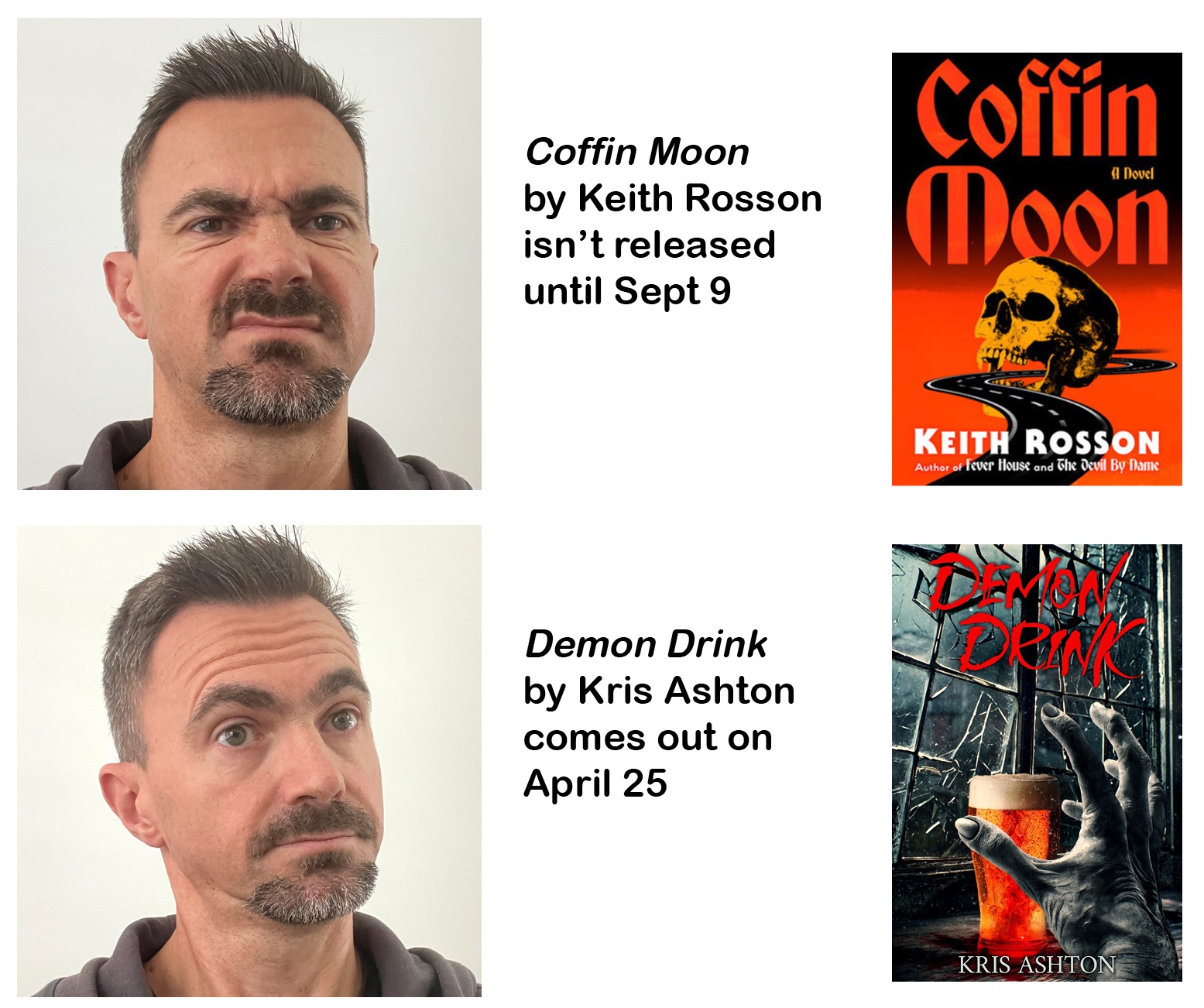
I’ve had readers suggest my novels Invasion at Bald Eagle and the soon-to-be-released Demon Drink are ripe for sequels, and every time I hear the S-word I break out in hives. I can understand where they’re coming from – both books leave narrative threads that could be picked up again – but the last thing I want to do is start a 100,000-word project that “at times can feel insurmountable”.
I’m pleased to report that, in spite of its title, Rosson’s next novel – Coffin Moon, due out in September – does not appear to be set in the same universe as the previous two books (or is only tangentially related if it is).
I bet Rosson had a lot more fun writing that one.


 Kris Ashton
Leave a comment