
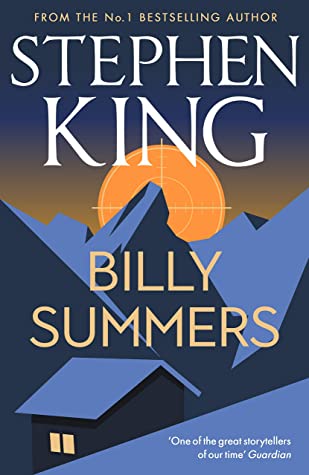
Stephen King’s greatest strength as an author, today and always, has been in rendering small-town America with affection and attention to detail. His perfunctory effort at doing so in Billy Summers is emblematic of the novel as a whole – promising concept, mediocre execution.
The titular Billy Summers is a former marine turned hitman with a difference: he only accepts jobs where he deems the target to be a ‘bad man’. In spite of this self-imposed moral code, he comes to believe he is little better than those he kills and decides to retire following one final high-paying job: $500,000 beforehand, another $1.5 million once the deed is done.
It requires that he set up not just one but three false identities. To his employers he is ‘dumb’ Billy Summers; he talks more slowly and reads comic books. In Gerard Tower (from which he will eventually take the shot) and at the suburban home in Midwood where he bides his time waiting for his target to be extradited, he is writer David Lockridge. And in a rundown part of town where he hides out incognito to let things blow over after he makes the hit, he is computer geek Dalton Smith.
It’s during Billy’s time in Midwood that the reader gets an inkling this novel isn’t pedigree King. Days after Billy moves in, his neighbours take a shine to him because… well, who knows, really; the relationships feel rushed and unconvincing. The neighbours themselves are little more than sketches and stereotypes. For reasons King also declines to elucidate, Billy abandons his tenet of never getting close to people and even has a one-night stand with a woman who works in Gerard Tower. Worst of all, this section – where Billy makes preparations for the hit while hosting backyard barbecues and playing Monopoly with next door’s kids – somehow manages to stretch credulity and be tedious. It’s long on description and internal monologue but short on anything resembling plot.
The hit goes off without a hitch; Billy is a crack shot and expert at disappearing afterwards. But two flies land in the ointment of his carefully crafted retirement plan. First, he suspects those bankrolling the hit are out to double-cross him and he ends up ignoring their getaway strategy, which saves his life but gives him enemies in high places. The second is more of a quandary: while Billy’s in his basement apartment, a van pulls up outside and three men dump an unconscious girl in the freezing rain before driving away. Rather than leave the girl, Alice, to die on the pavement, Billy risks blowing his cover and takes her inside his safe house to look after her.
It’s here that Billy Summers, already floundering for plausibility, really goes under. Alice has been drugged and gang-raped, yet the emotional fallout from this trauma amounts to a few panic attacks and the odd angsty expression. Within days she is enamoured of Billy – yes, in that way – even though he’s a hired killer and old enough to be her father. King tries to justify this absurd development in any number of ways, none of which is convincing.
Eventually Billy decides it’s safe to break cover and go after the men who stiffed him out of his retirement nest egg. Alice, naturally, insists on joining him. From here the plot becomes straight-up outlandish, with Billy and Alice effecting some Clouseau-esque disguises and infiltrating not one but two bad-guy compounds with ridiculous ease.
The desire to see whether Billy gets his payday and revenge on those who betrayed him keeps the reader chugging through the pages, but in the end it’s not enough. In the course of Billy Summers’ 400-odd pages it accumulates all the worst flaws typical of King’s latter-day fiction – irritating and pointless political references, working-class characters who are either right-wing caricatures or think in literary analogies, superfluous allusions to the supernatural, and not one but two characters who decide writing is their salvation. Most disappointing, though, is Billy’s life in Midwood. It has none of the richness that has been a King hallmark throughout his career (even in a hit-and-miss book like The Institute) and ultimately his time there has little bearing on the greater plot.
Told in the present tense for no discernible reason, Billy Summers can’t decide whether it’s a crime drama, a character study, a rumination on the horrors of war, a weird love story, or a paean to the redemptive qualities of writing. Due to its story-within-a story structure, it reminds me of ‘The Body’ from Different Seasons, which is ironic because the lasting impression is of a 100-page novella forced against its will to become a novel. Remove the protracted Midwood section and the clumsy Alice subplot and what remains is a lean and mean story about a hitman with a code questioning the validity of his morals. Instead, Billy Summers is an intricately plotted but contrived and oftentimes preposterous melodrama with grandiose literary pretensions.


 Kris Ashton
Leave a comment